Past Event Category: Talk
-
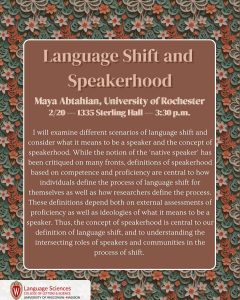 Feb 20Ling Fridays: Abtahian on language shift
1335 Sterling Hall
Language shift and speakerhood Maya Abtahian, University of Rochester In this talk I will examine different scenarios of language shift and consider what it means to be a speaker and the concept of speakerhood in these different scenarios. While the notion of the ‘native speaker’ has been critiqued on many fronts (Davies 2003), not least …
-
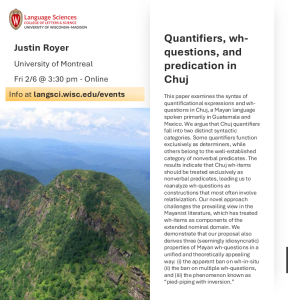 Feb 6Ling Fridays: Royer on quantification in Chuj
Online
Quantifiers, wh-questions, and predication in Chuj Justin Royer, University of Montreal (joint work with Cristina Buenrostro and Rodrigo Ranero) This paper examines the syntax of quantificational expressions and wh-questions in Chuj, a Mayan language spoken primarily in Guatemala and Mexico. Building on previous related work (Royer, Buenrostro & Jenks to appear), we argue that Chuj …
-
Jan 30
-
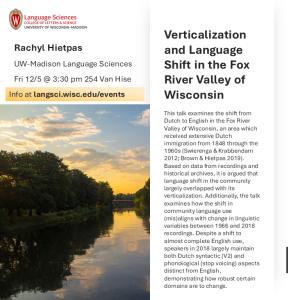 Dec 5Ling Fridays: Hietpas on Language Shift
254 Van Hise
Verticalization and Language Shift in the Fox River Valley of Wisconsin Rachyl Hietpas, Language Sciences In my talk, I examine the shift from Dutch to English in the Fox River Valley of Wisconsin, an area which received extensive Dutch immigration from 1848 through the 1960s (Swierenga & Krabbendam 2012; Brown & Hietpas 2019). I utilize …
-
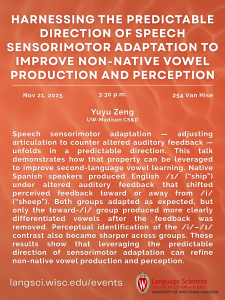 Nov 21Ling Fridays: Zeng on L2 vowels
254 Van Hise
Harnessing the predictable direction of speech sensorimotor adaptation to improve non-native vowel production and perception Yuyu Zeng, Communication Sciences & Disorders, UW–Madison Speech sensorimotor adaptation—adjusting articulation to counter altered auditory feedback—unfolds in a predictable direction. This talk demonstrates how that property can be leveraged to improve second-language vowel learning. Native Spanish speakers produced English /ɪ/ …
-
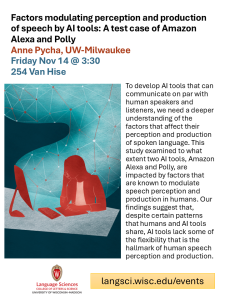 Nov 14Ling Fridays: Pycha on AI speech tools
254 Van Hise
Factors modulating perception and production of speech by AI tools: A test case of Amazon Alexa and Polly Anne Pycha, UW-Milwaukee To develop AI tools that can communicate on par with human speakers and listeners, we need a deeper understanding of the factors that affect their perception and production of spoken language. Thus, the goal …
-
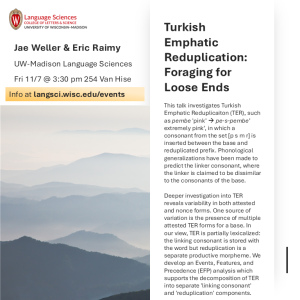 Nov 7Ling Fridays: Weller & Raimy on Turkish Reduplication
254 Van Hise
Turkish Emphatic Reduplication: Foraging for Loose Ends Jae Weller and Eric Raimy, Language Sciences TER is partial prefixing reduplication deriving an emphatic meaning for a limited number of words. Reduplication is the initial consonant (if present) and first vowel of the base, followed by a linking consonant from the set [p m s r]. …
-
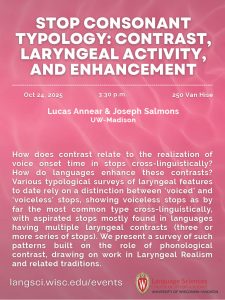 Oct 24Ling Fridays: Annear & Salmons on Consonant Typology
250 Van Hise
Stop Consonant Typology: Contrast, Laryngeal Activity, and Enhancement Lucas Annear & Joseph Salmons, Language Sciences How does contrast relate to the realization of voice onset time in stops cross-linguistically? How do languages enhance these contrasts? Various typological surveys of laryngeal features to date rely on a distinction between ‘voiced’ and ‘voiceless’ stops, showing voiceless stops …
-
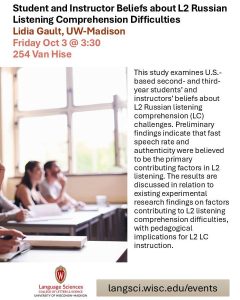 Oct 3Ling Fridays: Gault on Russian SLA
254 Van Hise
Student and Instructor Beliefs about L2 Russian Listening Comprehension Difficulties Lidia Gault, Doctoral Program in Second Language Acquisition, UW–Madison Listening is an integral part of learning second or foreign spoken languages (L2s). L2 listening used to be considered a passive skill; however, this view has shifted toward acknowledgement that L2 listening is a complex physiological …
-
 Jun 20Corrigan on colonialism and Irish English
294 Van Hise
Assessing the Linguistic Impact in Ireland of England’s First Experiment in the ‘Science of Settlement’ Karen P. Corrigan, Newcastle University A major debate that has evolved in research addressing Englishes which potentially arose through contact with Indigenous languages is the extent to which they should be considered ‘Colonial’, ‘Settler Colonial’ or indeed ‘Postcolonial’ varieties (Denis …