Past Event Category: Talk
-
Nov 12Panel: Bias in Automatic Speech Recognition
online
Professor Kelly Wright will be participating in an online panel discussion of issues surrounding bias regarding African American Speech in automatic speech recognition systems. Organized by the Center for Applied Linguistics
-
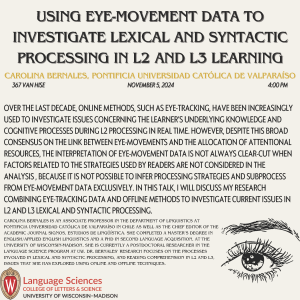 Nov 5Bernales on L2 and L3 Eye-tracking Research
367 Van Hise
Using eye-movement data to investigate lexical and syntactic processing in L2 and L3 learning Carolina Bernales, Pontificia Universidad Católica de Valparaíso Over the last decade, online methods, such as eye-tracking, have been increasingly used to investigate issues concerning the learner’s underlying knowledge and cognitive processes during L2 processing in real time (Bello & Bernales, …
-
Oct 29Romero on Maya standardization
online
Language standardization and colonialism in Guatemala Sergio Romero, University of Texas-Austin In this presentation I examine the tensions between the linguistic purism driving the standardization of Mayan languages in Guatemala, and the social meaning of regional variation in Maya communicational practices. I’ll consider examples from publications, interviews and overheard interactions, and will finish with some …
-
Oct 24Kim on Heritage accent
Memorial Union, Old Madison Room, 3rd floor East wing
Taking a holistic approach to characterizing heritage accent Ji Young Kim, UCLA The way we speak is a reflection of our language experience. While we all have an accent, accent is perceived when someone’s speech is different from the expected variety, be it standard, regional, native or monolingual, depending on the population of interest. …
-
Oct 21Font-Santiago on biological computational language modeling
367 Van Hise
Developing a Biological Computational Model of Natural Language: An Interdisciplinary Approach to Linguistics Cristopher Font-Santiago Ambiguity, the possibility of multiple mental representations and/or interpretations for one utterance, is a necessary, intrinsic, and pervasive feature of natural language. Previous approaches have focused on best capturing individual language modules, such as phonetic-phonological parsers (Church, 1987; Meng, 1995), …
-
Oct 7Antoine Hunter Dance performance
An Evening with Antoine Hunter Antoine Hunter will be providing a dance performance, lecture, and question and answer session about his career as a deaf dancer. Open to the public, ASL interpreters, and CART will be provided. View this invitation and directions to the event by our ASL instructor Taylor Koss!
-
Oct 7Deaf Fire: Finding Your Path in a Hearing World
Panel discussion with Antoine Hunter, Zahna Simon, and Jason Antoine. Panelists are all Deaf professionals who will use American Sign Language (ASL) for the discussion. Spoken English interpretation and live professional captioning (CART) will be provided. Moderator: Kate Lewandowski (Strategic Support Coordinator, National Deaf Center)
-
Oct 3
-
Oct 2Driver on Heritage Language Education
An Emotional Lens on Heritage Language Education: The Positive, the Negative, and the… Complicated for Heritage Students and Educators Meagan Driver, Michigan State University See the event page for registration and full information. SLA Talk Series on Emotion Research in Second Language Acquisition
-
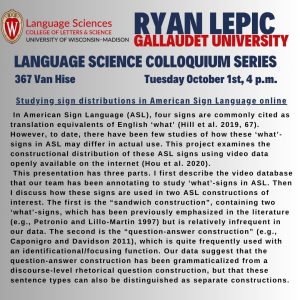 Oct 1Lepic on online ASL
367 Van Hise
Studying sign distributions in American Sign Language online Ryan Lepic, Gallaudet University Language Sciences Colloquium Series In American Sign Language (ASL), four signs are commonly cited as translation equivalents of English ‘what’ (Hill et al. 2019, 67). However, to date, there have been few studies of how these ‘what’-signs in ASL may differ in actual …