Past Event Category: Talk
-
Apr 15Ling Fridays: Vazquez on Ibero-Romance existentials and locatives
online
To Be, You Need a Place: A Diachronic Outlook of Current Existential and Locative Expressions in Ibero-Romance Luis Fernando Vazquez, UW–Madison, Spanish & Portuguese This study explores the current situation of thetic (i.e., existential) and categorical (i.e., locative) propositions from the point of view of Ibero-Romance, mainly from a diachronic perspective through examples of Portuguese, …
-
Apr 8Ling Fridays: Tejedo & Doroga on negative analogy
online
Negative Analogy: A New Direction for Analogical Change Fernando Tejedo (UW–Madison, Spanish & Portuguese) and Jason Doroga (Ouachita Baptist University) Analogy is generally described in historical linguistics as a mechanism of linguistic change that accounts for the creation of new forms (and the extension of existing ones) based on the influence of another form …
-
Apr 1Ling Fridays: Hu on NLP
Multilingual NLP: Cross-lingual Transfer Learning and Applications Junjie Hu, UW–Madison, Biostatistics & Computer Science Over the last decade, the phenomenal success of NLP systems has been mostly driven by deep neural networks and supervised machine learning approaches on a large amount of labeled data. However, it’s infeasible to annotate data under all possible real-world scenarios. …
-
Mar 25Ling Fridays: Slis on speech errors
Speech errors from an articulatory perspective; is there more than meets the ear? Anneke Slis, UW–Madison, Communication Sciences & Disorders For decades, the production and correction of speech errors has been a valuable source of information for linguists to model speech and language production processes. In general, errors were interpreted as originating at the cognitive …
-
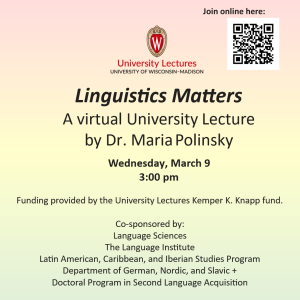 Mar 9University Lecture: Maria Polinsky “Linguistics Matters”
Linguistics Matters Maria Polinsky, UMD-College Park In this talk, I will present the main questions addressed in modern linguistics and will show how language can be used to assess the mind, brain, and culture, with a special emphasis on minority/minoritized, endangered, and heritage languages. Despite the complexity of linguistics as a discipline, there are certain …
-
Mar 7Martin on Language Processing
online
Constraints on theories of language processing Andrea Martin, Max Planck Institute for Psycholinguistics Human language is an example of a formally-describable system that is both statistical and algebraic. As such, its computational properties are markedly different than in other perception-action systems: hierarchical relationships between sounds, words, phrases, and sentences, structure-dependence, and the unbounded ability to …
-
Mar 2Baugh on linguistics for social justice
Just Linguistics John Baugh, Washington University in St. Louis Various linguistic methods have been utilized to promote the advancement of justice and equality throughout the world. Just Linguistics presents an overview of several instances where linguistic evidence and research were instrumental to the resolution of several social problems where considerations pertaining to languages or dialects …
-
Feb 28Frederiksen on sign language processing
online
Variation as a perspective on the interaction between language processing and cognition: Insights from sign language and bilingualism Anne Therese Frederiksen, UC-Irvine Languages are highly similar in how referring expressions are selected and resolved across discourse contexts. Recent findings, however, suggest that language processing may not always look the same across speakers and contexts. There …
-
Feb 25Goico on Deaf youth interaction
online
The Achievement of Exclusion and Inclusion in the Interactions of Deaf Youth in Peru Sara A. Goico Assistant Project Scientist Center for Language, Interaction, and Culture, UCLA Language is a pervasive part of our everyday lives. Yet around the world, there are many deaf individuals who live without sustained access to the linguistic resources of …
-
Feb 22Horton on sign language socialization
online
Becoming a participant: The significance of research on sign language acquisition and socialization Laura Horton, University of Chicago We have begun to understand the range of circumstances in which children develop language by documenting socializing practices in diverse communities with varied participant frameworks. The term participant frameworks describes the number of people taking part …