American Sign Language (ASL)
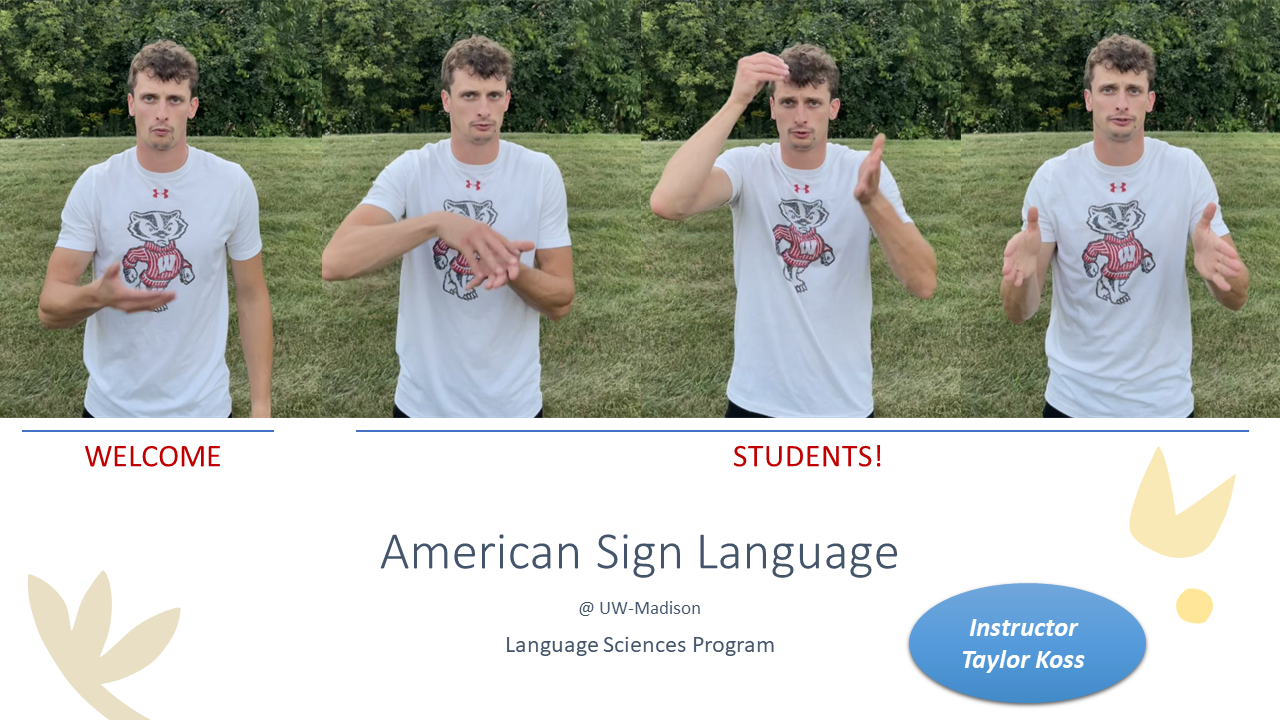
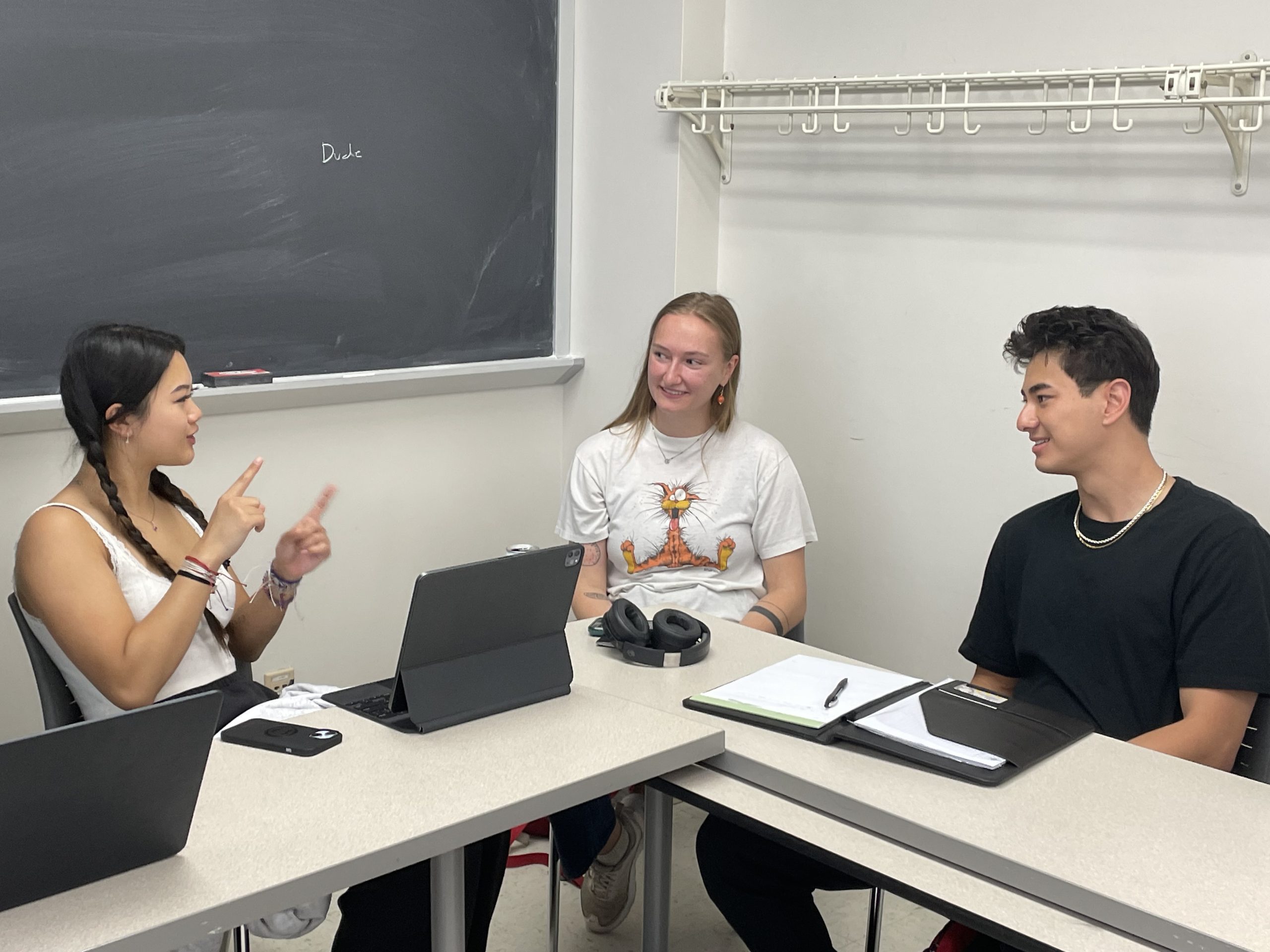
Summer session: ASL levels 1 and 2 can be taken back to back in two intensive 6-week sessions, meeting online Monday through Thursday mornings. Complete a full year of ASL in one summer! Courses are waitlisting, but inquire about seats.
Quick Links
Want updates?
Subscribe to our ASL listserv for news and announcements about ASL on campus! Just send an email (from your wisc.edu address) using this link:
Looking for ASL placement?
Incoming students with background in ASL should contact an instructor to sign up for placement testing:
Justin Vollmar – jdvollmar@wisc.edu
Language Sciences launched a new series of American Sign Language courses in 2023, and our growing program needs your support!
We now offer four semesters of ASL. We also offer courses on the linguistics of signed languages around the world, and topics courses such as Deaf Culture.
Our ASL courses are interactive language classes that focus on both communicative language skills and learning to appreciate Deaf culture. These courses can be used to satisfy the College of Letters & Science language requirement.
Look in the Linguistics section of the public course listings to see current offerings.
A gift to our ASL Instructor Fund can help support expanded offerings in ASL. A gift to our ASL Student Fund can provide scholarships to students studying ASL at UW–Madison.
Upcoming Course offerings
Please note that future course plans are tentative and subject to change.
- Summer 2026 (all courses online!)
- Ling 351: ASL 1
- Ling 352: ASL 2
- Fall 2026
- Ling 351: ASL 1
- Ling 353: ASL 3
- Ling 375: Sign Language Linguistics
- Spring 2027
- Ling 352: ASL 2
- Ling 354: ASL 4
- Ling 213: Language Emergence (Honors only)
Looking for an enjoyable way to learn about ASL and Deaf culture in the US? True Biz is a powerful novel that blends fictional stories of students at a residential school for the deaf with real information about ASL.
What is American Sign Language (ASL)?
American Sign Language is a natural human language, one of many human languages that use the visual and gestural system as a basis for communication, rather than the auditory and vocal systems used in spoken languages. ASL is based on the idea that sight is the most practical tool a deaf person has to communicate and collect messages. Handshapes, gestures, facial expressions, hand and body movements, position, and other visual cues are utilized to form words in ASL. ASL is not related to English, and has its own unique grammar and vocabulary.
Why study ASL?
Students should study ASL because it is used as a primary language of communication by hundreds of thousands of people in the United States. According to 2021 data from the Modern Language Association, ASL is the 3rd most popular non-English language at US colleges and universities. It is not only a fun and distinctive language to learn, but it also allows students to expand the range of their communicative options in the workplace and in their personal lives.
Courses
Ling 351-354: American Sign Language 1-4
Instructors: Taylor Koss, Justin Vollmar
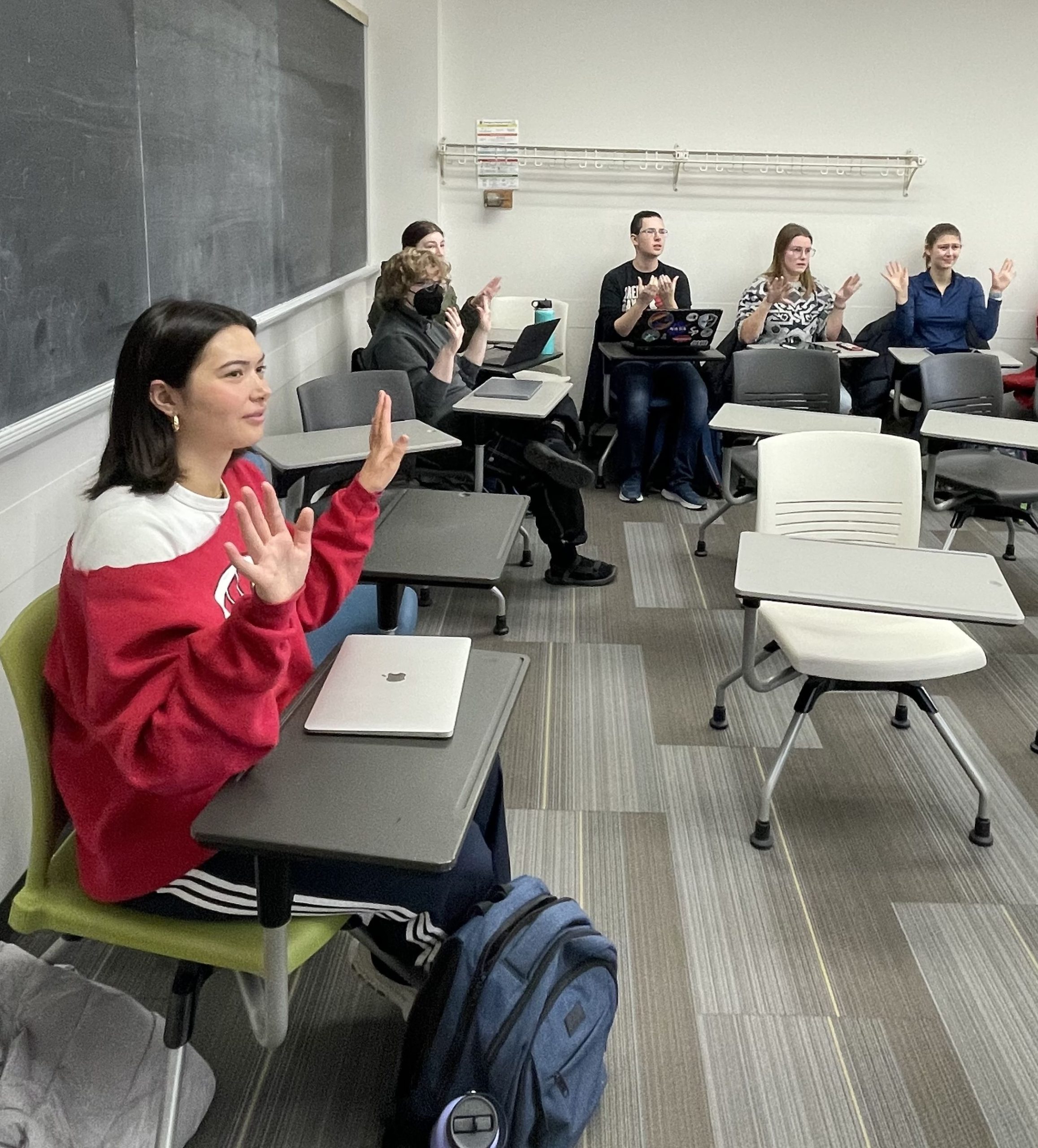
In this series of communicative language courses, you will develop conversational abilities (both production and comprehension) in ASL as you learn a broad range of vocabulary items, the grammar of ASL sentences and narratives, and accepted strategies for getting attention and initiating a conversational turn. You will also learn about Deaf cultural practices. An important theme will be understanding the cultural context of Deafness and signing in order to support communicative competence and cultural awareness. We will devote time to learning about important figures and events in the history of Deaf communities in the United States and across the world, and discuss issues of language access and inclusion.
Typical offering pattern
Fall: ASL 1 and 3
Spring: ASL 2 and 4
Summer: ASL 1 and 2 (all online)
ASL in the news!

Ling 213: Topics in Sociolinguistics – Language Emergence
Professor Laura Horton
For a long time, scientists thought that the origins of human language were inaccessible because we lacked records of the earliest spoken languages. But there actually are new languages around the world because sign languages emerge when deaf people come together in signing communities. We also have methods for studying language emergence in laboratory settings and through computer simulations. In this class we will explore a series of case studies of new and emerging sign languages and compare different methods for studying language emergence. We will also discuss the social and historical factors that lead to the emergence of new human languages.
Next Offered: Spring 2027

Ling 213: Topics in Sociolinguistics – Deaf Culture
Instructor Justin Vollmar
Learn about the rich and diverse culture of the Deaf community, examining its history, language, values, traditions, and social norms. Students will learn about the impact of American Sign Language (ASL) and other signed languages, the role of Deaf education, and the influence of Deaf organizations and activism.
Last Offered: Summer 2025
Ling 375: Sign Language Linguistics
Professor Laura Horton
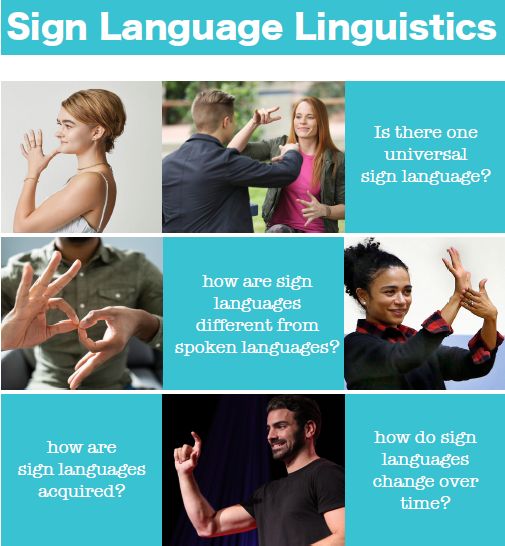
Introduction and overview of the linguistics of sign languages, signing communities, and perceptions of deaf people and sign languages. Topics will include: the grammar of sign languages, their use in signing communities, patterns in the transmission and acquisition of sign languages, and the emergence of new sign languages. No knowledge of American Sign Language is required. Prerequisite: Ling 101.
Next offered: Fall 2026
New Student Org – ASL Club Badgers Sign!
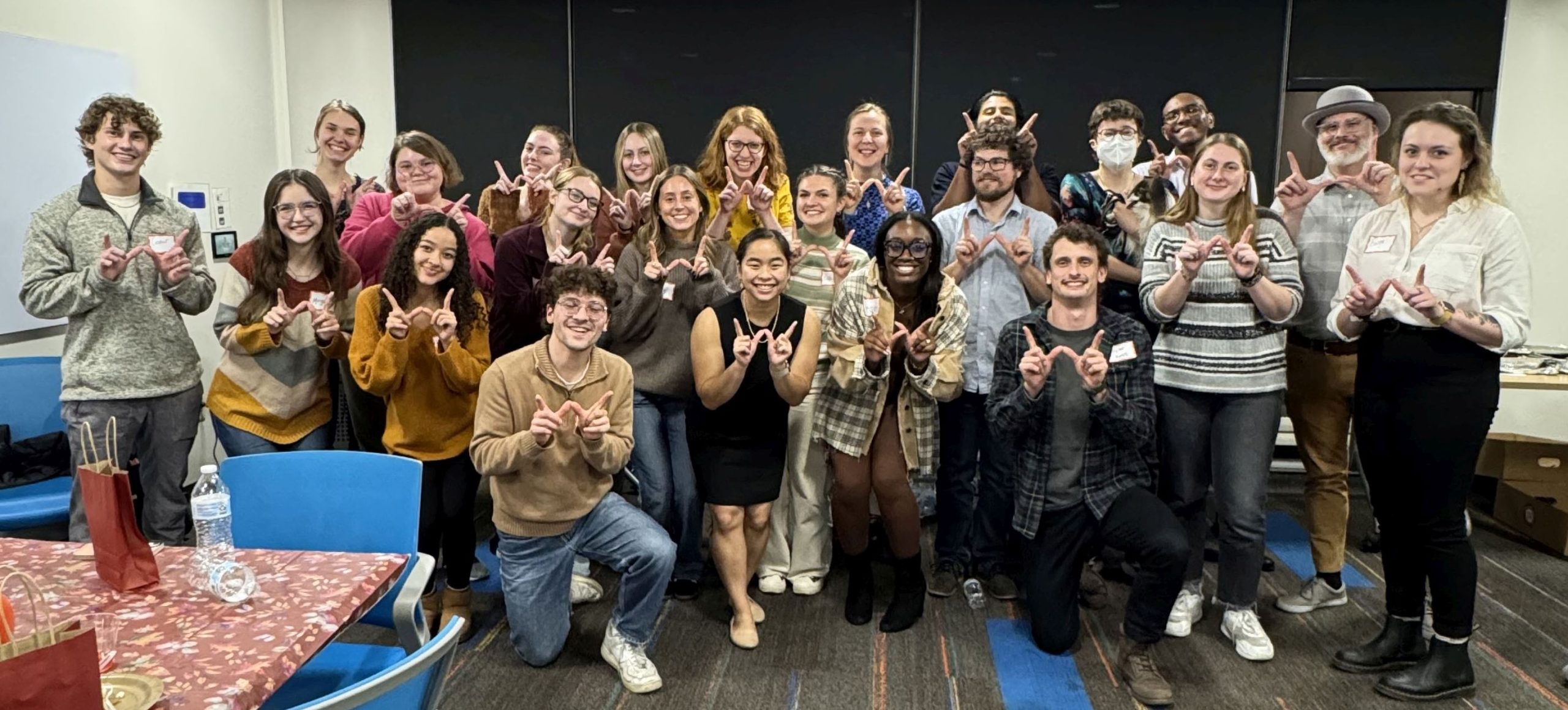
- Follow Badgers Sign on Instagram to learn more and join in!
- Open to all levels of signers, whether enrolled in ASL classes or not
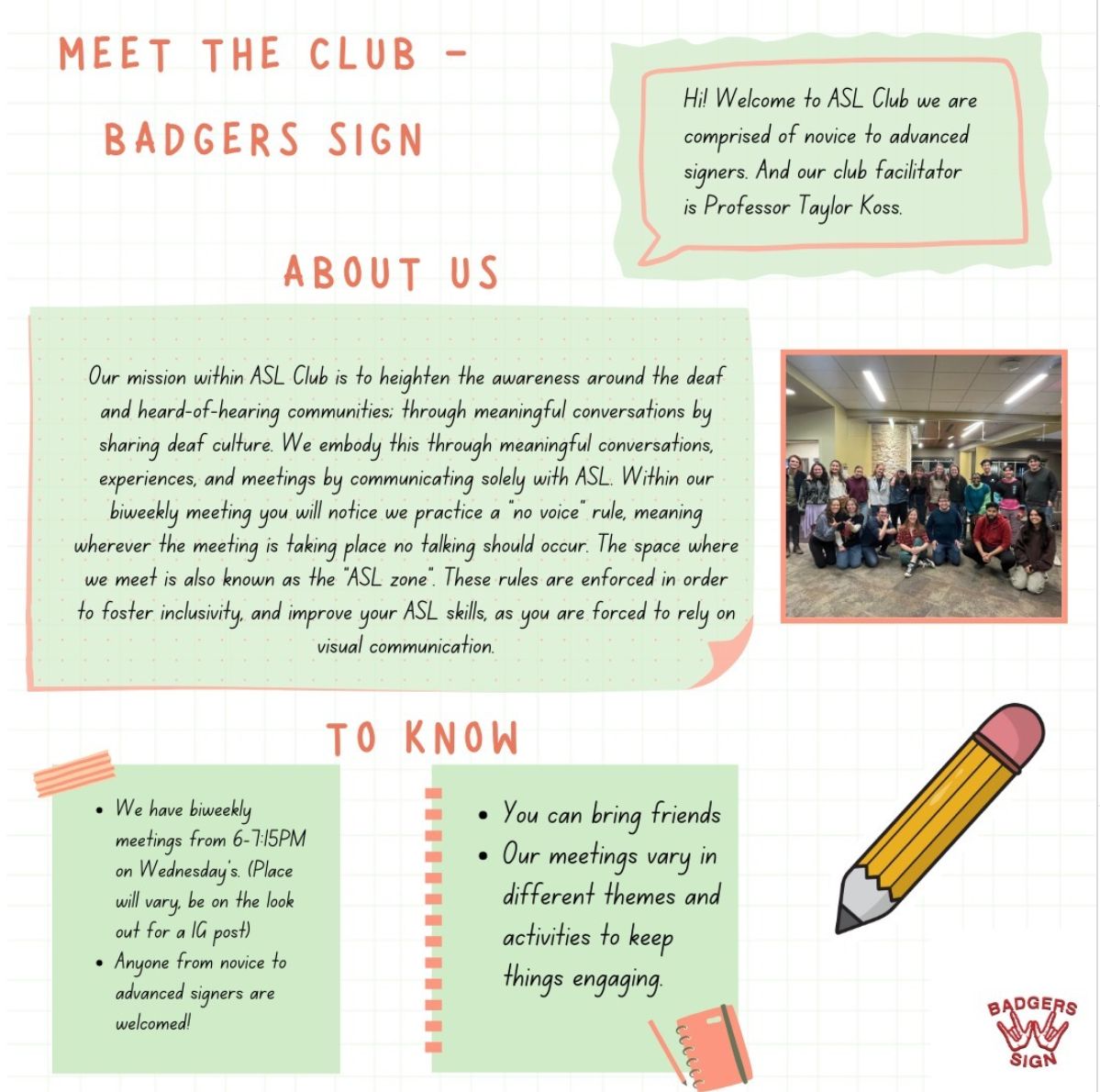
- Goals include sharing Deaf culture, raising awareness of Deaf and hard of hearing communities, and practicing ASL of course!
- Read this news story about Badgers Sign’s one-year anniversary on April 9, 2025!
FAQ
We use TRUE+WAY ASL as our digital course platform. TRUE+WAY ASL is a 100% Deaf owned and managed company, and their curriculum focuses on useful everyday communication. The platform is centered around rich and authentic video materials created by native ASL signers.
We also use supplemental cultural materials, such as Deaf Culture: Exploring Deaf Communities in the United States (2020), by Irene W. Leigh, et al.
Linguistics/Language Sciences offers a series of whole-language, communicative courses in ASL (Linguistics 351, 352, 353, 354). These courses are designed for people who want to achieve a high level of communicative proficiency in ASL: creatively producing and comprehending ASL across a wide variety of contexts and social settings, a thorough overview of ASL grammar and structure, an understanding of appropriate pragmatic usage, and knowledge and appreciation of Deaf culture and history. Classes are small with ample opportunity for interaction and are taught entirely in ASL. These are full 4-credit language courses, and can be used to satisfy the College of Letters and Science language requirement.
The Department of Communication Sciences and Disorders also offers courses that introduce ASL and MCE (CSD 424 Introduction to Sign Language and CSD 434 Sign Language in Health and Education) tailored to medical and other service providers working with deaf clients. The CSD courses include Manually Coded English/MCE (which is not ASL, but a system for directly translating English word for word into gestures). These classes have a larger lecture format with instruction in Deaf cultural issues centered around the students’ future profession, and as such are less focused on interaction and developing communicative skills in ASL. The CSD classes would be most appropriate for students who do not want or need a high level of proficiency in ASL broadly speaking, but who are planning to work in areas such as health care, education, counseling, or law, and may find rudimentary ASL communication and a deeper understanding of the deaf community useful in this professional context. CSD 424 and 434 do not count towards the L&S language requirement.
Yes, Linguistics 351 covers significantly more and different material than CSD 424 and 434, and students who have already taken a CSD class are welcome to enroll.
No, Linguistics 351 is a prerequisite for Linguistics 352. Ling 351 is a 4-credit class that covers more and different material than CSD 424 and 434, and the classes are not equivalent. Students will need to take Ling 351 before taking the second semester class, unless they have attained additional ASL proficiency through experiences outside of the CSD class. Speak to your instructor if you have questions about your personal situation.
Language Sciences offers four semesters of ASL (Linguistics 351, 352, 353, and 354). Students may be able to continue with even higher levels online at UW-Milwaukee and transfer credits over (see the question about transfer credits below). We have partnered with UW-Milwaukee to make sure our curriculum lines up so that students will be able to move seamlessly between our programs. Contact UW-Milwaukee ASL program director Sunny Brysch directly to discuss enrollment options, and speak with your academic advisor about how transfer credits will work in your situation. See here for important information about concurrent enrollment credit limits.
Badgers Sign UW is a Registered Student Organization for students interested in ASL from across campus! The group generally meets biweekly, with a goal of raising awareness and increasing understanding of Deaf culture and community issues, practicing ASL together, and having fun with ASL games. Follow them on Instagram for more info.
We do not offer a certificate, but taking ASL courses will help you develop important and useful skills that may be relevant to your life and work.
Non-degree students (including high school student juniors and seniors) are able to enroll in UW for-credit classes as “special students.” There is more info on enrolling as a special student at the Adult Career and Special Student Services page – contact that office directly for information and assistance.
Keep in mind that enrollment for special students is available only if there is space left in the class after degree students enroll. Due to the interactive nature of ASL classes, enrollment is limited, and we cannot guarantee that spots will be available for non-degree students. Summer may be your best chance to find open seats.
Because ASL is a highly participatory class, auditing or attending unofficially is not possible, including senior auditors.
Yes, send a transcript to the Admissions office for evaluation.
In order to count towards the L&S Language Requirement, the course must transfer as direct equivalent to LINGUIS 351-354, or with the following equivalents:
RP & SE X01 – First Semester ASL
RP & SE X02 – Second Semester ASL
RP & SE X03 – Third Semester ASL
RP & SE X04 – Fourth Semester ASL
Check Transferology or work with Credit Evaluation Services to see how ASL classes taken at another institution will transfer to UW–Madison.
In most cases it will be best for students to start with Linguistics 351: ASL 1, to make sure that the student does not have any gaps in their learning, and to ensure familiarity with our TRUE+WAY curriculum. If a student has significant prior experience with ASL, they should take a placement test to determine which level is best for them.
Contact instructor Justin Vollmar (jdvollmar@wisc.edu) to schedule placement testing.
Madison College offers non-credit ASL classes year-round, with multiple levels. These Madison College courses would be a great option for non-UW students and community members who want to learn about ASL and Deaf culture in a non-credit environment.
Our Fall and Spring ASL classes are in person only. Our Summer courses are offered in an online format. Online classes in ASL are also offered year-round at UW-Milwaukee. Contact UW-Milwaukee ASL program director Sunny Brysch directly to discuss UWM enrollment options.