
Education
Ph.D. Germanic Linguistics, University of Texas-Austin, 1984
B.A. Philosophy, University if North Carolina-Charlotte, 1978
Biography
Joe Salmons is the Lester W.J. “Smoky” Seifert Professor of Linguistics. He is Vice President and President Elect of the American Dialect Society. His research focuses on language change and linguistic theory, especially as it bears on sound systems. He is the author of Sound Change (Edinburgh University Press, 2021) and Dialect (forthcoming), and co-editor, with Jeroen Darquennes and Wim Vandenbussche, of Contact Linguistics (volume 2, de Gruyter Handbooks, 2025). He also works to integrate research in linguistics with teaching and outreach beyond the university. With Jim Leary, he co-founded the Center for the Study of Upper Midwestern Cultures and (co-)directed it until 2022.
Teaching
Ling 237: Language in Wisconsin (CommB course)
Ling 303: Historical Linguistics
Ling 373: Topics in Linguistics
– Dialect
– Language Change in Progress
– Historical Sociolinguistics
Ling 690: Capstone
– Laryngeal Realism
– Development of Wisconsin English
– Algonquian Phonology
Ling 977: Seminar
– Speech sounds and sound systems in language contact
– Laryngeal Realism
– Sound Change
Selected Publications
Forthcoming Laura Horton and Joseph Salmons. Irregularity and sound change in signed and spoken languages. Language.
Forthcoming David Natvig and Joseph Salmons. Final laryngeal neutralization. Companion to Phonology. Second edition.
2025 Joshua R. Brown, David Natvig and Joseph Salmons. eds. Historical Sociolinguistics. Special issue of Abralin.
2025 Jeroen Darquennes, Wim Vandenbussche and Joseph Salmons, eds. Contact Linguistics. Berlin: de Gruyter Handbooks. Volume 2.
2024 Rachyl Hietpas, Mirva Johnson, Laura Moquin, Joseph Salmons and Charlotte Vanhecke, eds. Selected proceedings of the 14th Workshop on Immigrant Languages in the Americas. Bergen: Bergen Language and Linguistics Studies.
2022 Cristopher Font-Santiago, Mirva Johnson and Joseph Salmons. Reallocation: How new forms arise from contact. Language and Linguistic Compass. 16.8. e12470. https://compass.onlinelibrary.wiley.com/doi/10.1111/lnc3.12470
2021 Sound Change. Edinburgh University Press.
2021 Alexandra D’Arcy and Joseph Salmons. Peer review in linguistics journals: Best practices and emerging standards. Language. 97(4). e383-e407.
2018 A History of German: What the past reveals about today’s language. Second edition. Oxford: Oxford University Press.
2016 Monica Macaulay and Joseph Salmons. Synchrony and diachrony in Menominee derivational morphology. Morphology 27. 179–215.
1995 Gregory K. Iverson & Joseph C. Salmons. Aspiration and Laryngeal Representation in Germanic. Phonology 12. 369-396.
1992 Accentual Change and Language Contact: Comparative survey and case study of early northern Europe. Stanford, Ca.: Stanford University Press and London: Routledge.
1990 Bilingual Discourse Marking: Codeswitching, borrowing and convergence in some German-American Dialects. Linguistics 28. 453-480.
Website
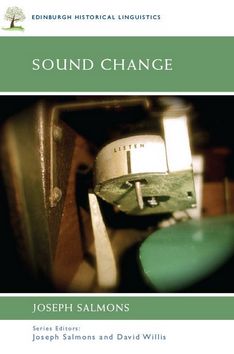
Sound Change
Salmons, J. Sound Change.
Understanding sound change through contemporary theory and historical evidence Offers broad linguistic coverage with examples from a wide range of world language families including Germanic, Romance, Mixtec, Tibetan, Hmong, Hebrew, Chinese, Kikuyu, Svan and Menominee Explores sound change from structural, historical, sociolinguistic and acquisitional perspectives Takes a data led approach with worked examples in each chapter Includes questions and suggestions for further study at the end of each chapter Drawing examples from a range of world languages, this textbook introduces the ways in which speech sounds become different over time. It explores how we produce and hear particular sounds and how overall word shapes and the pronunciation of individual words change. The roles of phonetics and phonology, morphology and syntax, traditional formal models and recent exemplar-based work in sound change are all examined. In covering both structural and societal issues, the book integrates different kinds of historical evidence and different theories into a coherent understanding of the full process of sound change.
Language Contact: An International Handbook, Vol. 1
Darquennes (Co-editor), J., J. Salmons (Co-editor), and W. Vandenbussche (Co-editor). Language Contact: An International Handbook, Vol. 1.
Language Contact. An International Handbook offers a comprehensive overview of current topics in research on language contact. Broadly conceived, it stands out for its international approach to language contact, complementing the theoretical state-of-the-art with examples from traditionally eclipsed areas and languages. Next to a thorough introductory overview of the ground-breaking methodological and theoretical approaches that shaped the discipline, ample attention goes to the new and innovative insights on language contact in the 21st century. Combining concise introductory contributions with in-depth treatment of the most relevant case studies in the field, the handbook speaks to both junior and established scholars.
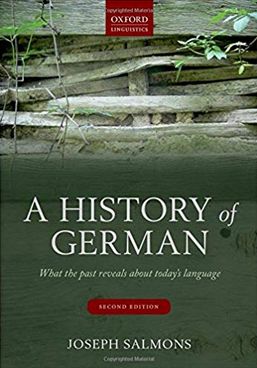
A History of German: What the Past Reveals About Today’s Language
Salmons, J. A History of German: What the Past Reveals About Today’s Language.
This book provides a detailed but accessible introduction to the development of the German language from the earliest reconstructable prehistory to the present day. Joe Salmons explores a range of topics in the history of the language, offering answers to questions such as: How did German come to have so many different dialects and close linguistic cousins like Dutch and Plattdeutsch? Why does German have ‘umlaut’ vowels and why do they play so many different roles in the grammar? Why are noun plurals so complicated? Are dialects dying out today? Does English, with all the words it loans to German, pose a threat to the language? This second edition has been extensively expanded and revised to include extended coverage of syntactic and pragmatic change throughout, expanded discussion of sociolinguistic aspects, language variation, and language contact, and more on the position of German in the Germanic family. The book is supported by a companion website and is suitable for language learners and teachers and students of linguistics, from undergraduate level upwards. The new edition also includes more detailed background information to make it more accessible for beginners.
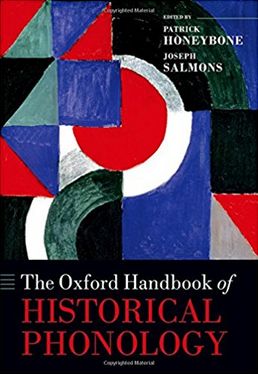
The Oxford Handbook of Historical Phonology
Salmons (Co-editor), J., and P. Honeybone (Co-editor). The Oxford Handbook of Historical Phonology.
This book presents a comprehensive and critical overview of historical phonology as it stands today. Scholars from around the world consider and advance research in every aspect of the field. In doing so they demonstrate the continuing vitality and some continuing themes of one of the oldest sub-disciplines of linguistics. The book is divided into six parts. The first considers key current research questions, the early history of the field, and the structuralist context for work on segmental change. The second examines evidence and methods, including phonological reconstruction, typology, and computational and quantitative approaches. Part III looks at types of phonological change, including stress, tone, and morphophonological change. Part IV explores a series of controversial aspects within the field, including the effects of first language acquisition, the status of lexical diffusion and exceptionless change, and the role of individuals in innovation. Part V considers theoretical perspectives on phonological change, including those of evolutionary phonology and generative historical phonology. The final part examines sociolinguistic and exogenous factors in phonological change, including the study of change in real time, the role of second language acquisition, and loanword adaptation. The authors, who represent leading proponents of every theoretical perspective, consider phonological change over a wide range of the world’s language families. The handbook is, in sum, a valuable resource for phonologists and historical linguists and a stimulating guide for their students.
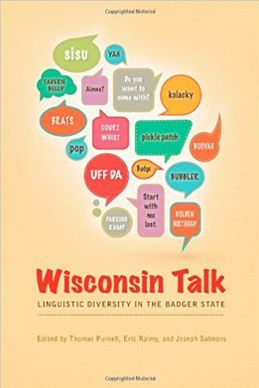
Wisconsin Talk: Linguistic Diversity in the Badger State
Salmons (Co-editor), J., E. Raimy (Co-editor), and T. Purnell (Co-editor). Wisconsin Talk: Linguistic Diversity in the Badger State.
Wisconsin is one of the most linguistically rich places in North America. It has the greatest diversity of American Indian languages east of the Mississippi, including Ojibwe and Menominee from the Algonquian language family, Ho-Chunk from the Siouan family, and Oneida from the Iroquoian family. French place names dot the state’s map. German, Norwegian, and Polish—the languages of immigrants in the nineteenth and early twentieth centuries—are still spoken by tens of thousands of people, and the influx of new immigrants speaking Spanish, Hmong, and Somali continues to enrich the state’s cultural landscape. These languages and others (Walloon, Cornish, Finnish, Czech, and more) have shaped the kinds of English spoken around the state. Within Wisconsin’s borders are found three different major dialects of American English, and despite the influences of mass media and popular culture, they are not merging—they are dramatically diverging. An engaging survey for both general readers and language scholars, Wisconsin Talk brings together perspectives from linguistics, history, cultural studies, and geography to illuminate why language matters in our everyday lives. The authors highlight such topics as: • words distinctive to the state • how recent and earlier immigrants have negotiated cultural and linguistic challenges • the diversity of bilingual speakers that enriches our communities • how maps can convey the stories of language • the relation of Wisconsin’s Indian languages to language loss worldwide.
A Word Atlas of Pennsylvania German
Seifert, L. W. J., M. Louden (Co-editor), J. Salmons (Co-editor), and H. Martin (Co-editor). A Word Atlas of Pennsylvania German.
This is the most extensive reference work documenting linguistic variations in Pennsylvania German (also known as Pennsylvania Dutch), the dialect now spoken primarily by Old Order Amish and Old Order Mennonite communities in the United States. This Word Atlas displays more than 170 maps showing regional variants for a word or grammatical form throughout the former German-speaking regions of southeastern Pennsylvania, as well as helpful maps of Pennsylvanian geographical features and political boundaries. One of the pioneers in linguistic research on this dialect, Lester W. J. Seifert of the University of Wisconsin–Madison and his colleague Carroll Reed of the University of Washington interviewed almost 100 speakers in these regions during the 1940s, using an extensive questionnaire. This research, graphically represented in the Word Atlas, is an invaluable record of a historically and culturally important language that is rapidly dying out. The volume also reprints four of Seifert’s classic essays on the dialect geography of Pennsylvania German, as well as biographies of the linguistic consultants, an original essay on the development of Pennsylvania German dialectology and linguistics by Mark Louden, and a new biography of Seifert by Howard Martin and Suzanne Treichel.