
Education
Ph.D. Massachusetts Institute of Technology, 1990
M.A. Shandong University, 1985
B.A. Shandong University, 1982
Teaching
Ling 309: Grammatical Variability of Language
Ling 330: Syntax
Ling 373: Topics in Linguistics – Morphosyntax
Ling 427: Field Methods II – Cantonese
Ling 530: Syntactic Theories
Ling 977: Seminar
– Syntax and Linearization
– UG with Iconicity
– On Bare Roots
Selected Publications
Non-canonical arguments via the high applicative. 2022. In Simpson, ed., New Explorations in Chinese Theoretical Syntax. Benjamins, pp. 331-356.
On an integral theory of word-formation in Chinese and beyond. 2022. In Huang, C.-R., Y.-H. Lin and I.-H. Chen (eds.), Cambridge Handbook of Chinese Linguistics. Cambridge University Press, pp. 174-197.
Universal Grammar and Iconicity. 2022. Cambridge University Press.
(co-authored with Zhe Chen). Bipartite agentivity expression in Chinese passives. 2021. Syntax 4:123-141.
Liberal thematic arguments and v. To appear. In S. Feng and D. Tsai (eds.), Studies in Chinese Light Verbs. Beijing University Press.
What can biolinguistics learn from biology? 2018 Waiyu Jiaoxue yu Yanjiu 50.3 (co-authored with Zhe Chen).
Chinese Syntax. 2016. In Routledge Encyclopedia of the Chinese Language. Routledge.
Argument structure. 2016. In Wolfgang Behr, G. Yueguo, Z. Handel, C.-T. Huang, and R. Sybesma (eds), Encyclopedia of Chinese Language and Linguistics, vol 1. Brill.
Is UG like a chunk of Swiss cheese? Evidence for a “third-factor” principle. 2013. Language and Linguistics 14:737-754.
Adverb classes and the nature of minimality. 2012 Natural Language and Linguistic Theory 30.1 (co-authored with Rebecca Shields and Vivian Lin).
The Syntax of Chinese. 2009. Cambridge University Press (co-author, with James Huang and Audrey Li).
X0: A Theory of the Morphology-Syntax Interface. 2005. MIT Press.
Cross-componential causativity. 1999. Natural Language and Linguistic Theory 17.4.
X0-binding and verb incorporation. 1990. Linguistic Inquiry 21.3.
On V-V compounds in Chinese. 1990. Natural Language and Linguistic Theory 8.2.
Yafei Li’s complete publication list
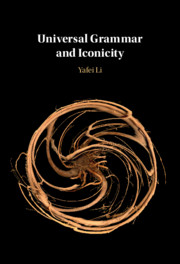
Universal Grammar and Iconicity
Li, Y. Universal Grammar and Iconicity. 2022.
Within linguistics, the formal and functional approaches each offer insight into what language might be and how it operates, but so far, there have been hardly any systematic attempts to integrate them into a single theory. This book explores the relationship between universal grammar – the theory that we have an innate mechanism for generating sentences – and iconicity – the resemblance between form and meaning in language. It offers a new theory of their interactions, ‘UG-iconicity interface’ (UG-I), which shows that not only do universal grammar and iconicity coexist, but in fact collaborate in intricate and predictable ways. The theory explains various recalcitrant cross-linguistic facts surrounding the serial verb constructions, coordination, semantically and categorically obscure ‘linkers’, the multiple grammatical aspects of the external argument, and non-canonical arguments. This groundbreaking work is essential reading for researchers and postgraduate students in linguistics, as well as scholars in psychology and cognitive science.
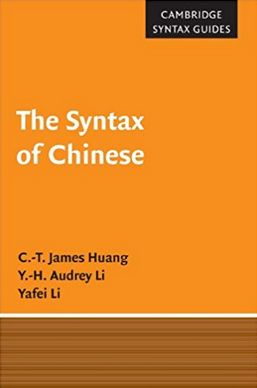
The Syntax of Chinese
Li, Y., C.-T. J. Huang, and Y.-H. A. Li. The Syntax of Chinese. 2009.
The past quarter of a century has seen a surge in Chinese syntactic research that has produced a sizeable literature on the analysis of almost every construction in Mandarin Chinese. This guide to Chinese syntax analyses the majority of constructions in Chinese that have featured in theoretical linguistics in the past 25 years, using the authors’ own analyses as well as existing or potential alternative treatments. A broad variety of topics are covered, including categories, argument structure, passives and anaphora. The discussion of each topic sums up the key research results and provides new points of departure for further research. This book will be invaluable both to students wanting to know more about the grammar of Chinese, and graduate students and theoretical linguists interested in the universal principles that underlie human languages.
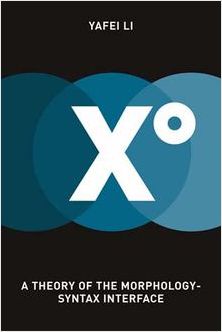
X0: A Theory of the Morphology-Syntax Interface
Li, Y. X0: A Theory of the Morphology-Syntax Interface. 2004.
This important monograph offers a resolution to the debate in theoretical linguistics over the role of syntactic head movement in word formation. It does so by synthesizing the syntactic and lexicalist approaches on the basis of the empirical data that support each side. In trying to determine how a morphologically complex word is formed in Universal Grammar, generative linguists have argued either that a substantial amount of morphological phenomena result from head movement in overt syntax (the widely adopted syntactic approach) or that morphological/lexical means are both necessary and sufficient for a theory of word formation (the Lexicalist Hypothesis). Li examines both the linguistic facts that are brought to light for the first time and the existing data in the literature and shows that each side has an empirical foundation that cannot be negated by the other. Since neither approach is adequate to explain all the facts of word formation, he argues, the way to achieve a unified account lies in synthesizing the empirically advantageous portions of both approaches into one simple and coherent theory.Li begins by demonstrating how a theory that combines the essence of the syntactic and lexicalist approaches can account more accurately for the various morphological constructions analyzed in the literature by means of syntactic verb incorporation. He then examines causativization on the adjectival root, noun incorporation in polysynthetic languages, and the possibility that the word formation part of the Lexicalist Hypothesis―which is crucial to his theory―can be derived as a theorem from a version of the X-bar theory. He concludes by discussing methodological issues in current linguistic research.