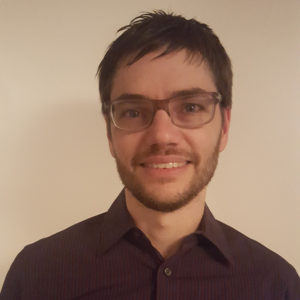
Biography
Department of Spanish & Portuguese
Education
Ph.D., Georgetown University
B.A., University of California, Berkeley
Research Statement
Grant Armstrong’s research centers on the description and analysis of the grammar of different varieties of Spanish and Mayan languages. His focus is on applying generative theories of morphosyntax to Spanish and Mayan languages in addition to language description and documentation.
Teaching
Span 320: Spanish Phonetics
Span 321: Structure of Modern Spanish
Span 327: Introduction to Spanish Linguistics
Span 446: Topics in Spanish Linguistics
– Introduction to Spanish Syntax from a Generative Perspective
– Mayan Languages and Linguistics
– Advanced Spanish Syntax
Span 630: Topics in Hispanic Linguistics – Morphosyntactic Variation
Span 815: Seminar – What’s the word? Topics in Morphological Description and Theory
Website
CV
Selected Publications
Armstrong, G. & J.E. MacDonald (eds.) 2021. Unraveling the Complexity of SE. Dordrecht: Springer.
Fábregas, A., V. Acedo-Matellán, G. Armstrong, M.C. Cuervo & I. Pujol Payet (eds.) 2021. The Routledge Handbook of Spanish Morphology. New York: Routledge.
Lexis. In K. Geeslin (ed.) The Cambridge Handbook of Hispanic Linguistics, 415-436. Cambridge, UK: Cambridge University Press, 2018
SE-marked directed motion constructions: anticausatives and figure reflexives. In J. MacDonald (ed.) Contemporary trends in Hispanic & Lusophone Linguistics, 11-30. Amsterdam/Philadelphia: John Benjamins, 2017
The syntax of non-verbal predication in Yucatec Maya. Cuadernos de Lingüística de El Colegio de México 4(2): 137-212, 2017
Spanish participios activos are adjectival antipassives. The Linguistic Review 34(1): 1-37, 2017
Una “buena” manera de hablar acerca de grados: bien con adjetivos en español. Studies in Hispanic and Lusophone Linguistics 9(2): 401-427 (with Alberto Pastor), 2016
Spanish unspecified objects as null incorporated nouns. Probus 28(2): 165-230, 2016
Pronominal verbs in Spanish. Studies in Hispanic and Lusophone Linguistics 9(1): 29-65, 2016
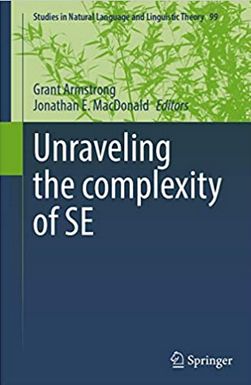
Unraveling the Complexity of SE
Armstrong (Co-editor), G., and J. E. MacDonald (Co-editor). Unraveling the Complexity of SE.
This book makes a novel contribution to our understanding of Romance SE constructions by combining both diachronic and synchronic theoretical perspectives along with a range of empirical data from different languages and dialects. The collection, divided into four sections, proposes that SE constructions may be divided into one class that is the result of grammaticalization of a reflexive pronoun up the syntactic tree, from Voice and above, and another class that has resulted from the reanalysis of reflexive and anticausative morphemes as an argument expletive or verbal morpheme generated in positions from Voice and below. The contributions, while varied in both empirical content and theoretical approach, all serve to highlight different aspects of the overarching idea that SE constructions have evolved from these two distinct grammaticalization paths. The book appeals to researchers and academics in the field and closes with a unified approach to various SE constructions that makes important use of its status as a verbal morpheme. In addition to aligning a novel string of empirical contributions under a new theoretical umbrella, a clear research direction emerges from this volume based on the morphosyntactic nature of SE itself: Is it a clitic, an agreement morpheme, or a verbal morpheme?
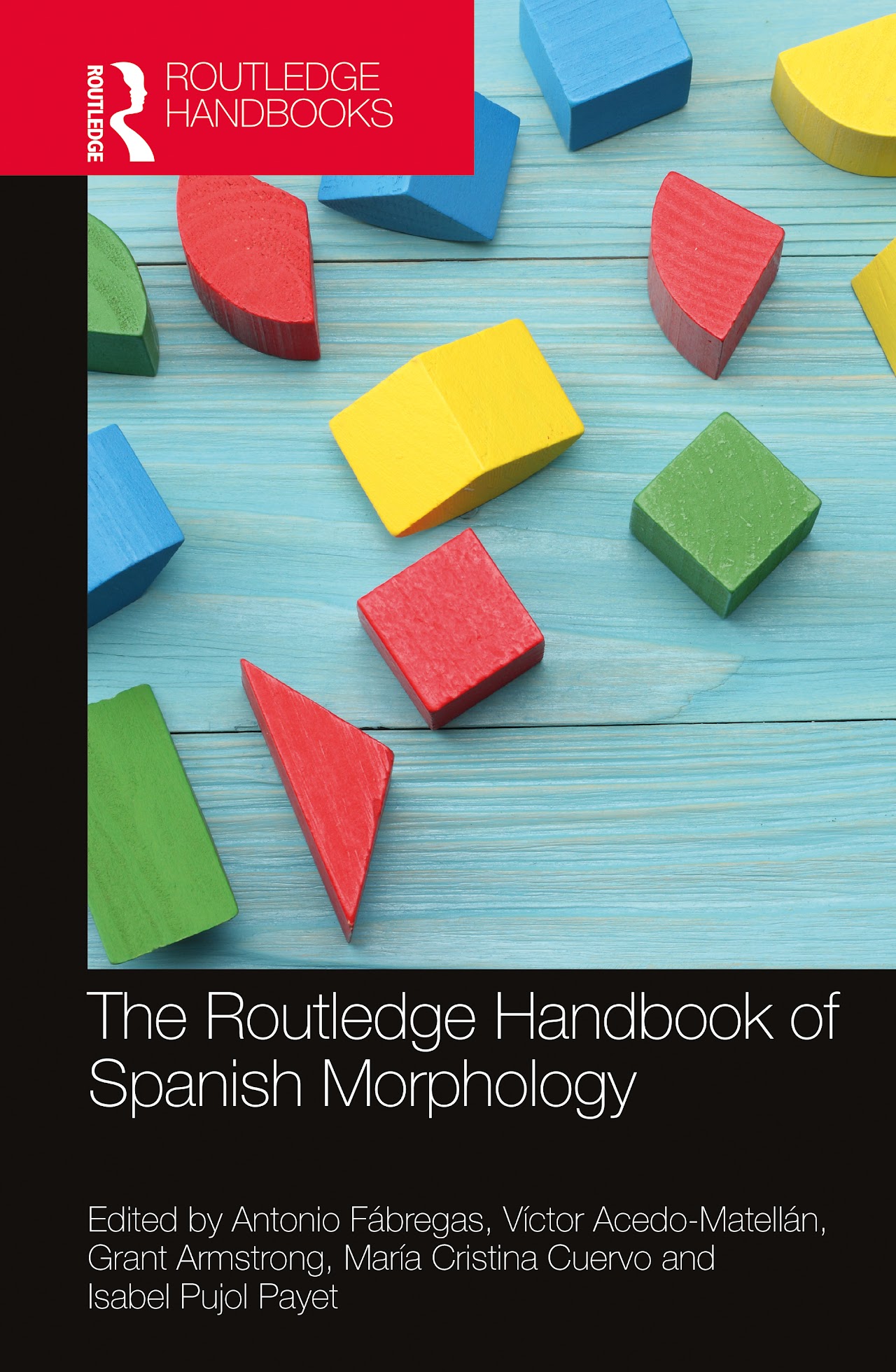
The Routledge Handbook of Spanish Morphology
Fábregas (Co-editor), A., V. Acedo-Matellán (Co-editor), G. Armstrong (Co-editor), M. C. Cuervo (Co-editor), and I. Pujol Payet Abingdon (Co-editor). The Routledge Handbook of Spanish Morphology.
The Routledge Handbook of Spanish Morphology presents a state-of-the-art, detailed and exhaustive overview of all aspects of Spanish morphology, paying equal attention to the empirical complexities of the morphological system and the theoretical issues that they raise. As such, this handbook is relevant both for those interested in the facts of Spanish morphology and those interested in general morphology that want to explore how the Spanish facts illuminate our understanding of human language and current theories of morphology. This volume is also unique in its extent and coverage. Written by an international team of leading experts in the field, it contains 42 chapters divided into four sections, covering all synchronic and diachronic aspects of Spanish morphology, including inflection; derivation; compounding and other processes of word formation; the interaction of morphology with other modules of grammar and the role of morphology in language acquisition, psycholinguistics and language teaching.