Past Event Category: Talk
-
Apr 21Ling Fridays: Sampson on the copula SELF in ASL
online
The use of the copular SELF with adjectives in ASL Tory Sampson, PhD student, University of California-San Diego online Nonverbal predication has not been adequately described in American Sign Language. Contrary to previous claims that there are no copulas in ASL (Bellugi & Fischer 1972, Liddell 1980, Valli et al. 2011, Hill et al. 2018), …
-
Apr 21Ling Fridays: Keating on Quechua Pseudo-reflexives
201 Van Hise
An analysis of Quechua’s pseudo-reflexive morphemes Cailie Keating, undergraduate Linguistics and Spanish major, will present her Hilldale research project that she is completing with Professor Grant Armstrong. In person Reflexivity can generally be defined as a process whereby reflexive verbs have subjects that are also considered their direct objects, thus allowing the action of the …
-
Apr 7Ling Fridays: Drake on disrupting linguistic bias
online
Disrupting linguistic bias through experiential learning in an introductory linguistics class Veronika Drake, Saginaw Valley State University Abstract: Prejudice about groups of people simply based on their dialect (Baker-Bell, 2020; Lippi-Green, 2012) is not only very common, it is also known as the backdoor to discrimination (Landecker, 2016). In this pilot study, I implemented experiential learning …
-
Apr 4Biggam on color semantics
399 Van Hise
An introduction to color semantics Carole Biggam, University of Glasgow In person Most people rarely question the principal color terms of their language, for example, red, blue, green in English. However, around the world, languages divide the color space in different ways, may have only a few principal color terms, may use them only in …
-
Apr 3CSD Proseminar with Erika Skoe
Environmental influences on hearing: Insights from wearable technologies and blood-based biomarkers Department of Communication Sciences and Disorders Proseminar with: Erika Skoe, Associate Professor and UW–Madison Linguistics alum! Department of Speech, Language, and Hearing Sciences Director of Cognitive Science Program University of Connecticut Real-world auditory environments have rich acoustic properties that fluctuate in frequency and intensity …
-
 Mar 1Ling Fridays: Ó Dochartaigh on Irish language revitalization
120 Ingraham
Oideas Gael: a social enterprise model for language revitalization Rónán Ó Dochartaigh, Oideas Gael In person in 120 Ingraham Hall, and online (advanced registration required for online attendance). (Note: you need to be logged in to Zoom to access the recording. Sign in first here. If you don’t have a Zoom account, you can sign …
-
Mar 1Languages of the World Day
Rebecca Shields of Language Sciences will be leading a session on sounds of the world’s languages and the International Phonetic Alphabet at this outreach program for Wisconsin high school students. See the Event website for more information.
-
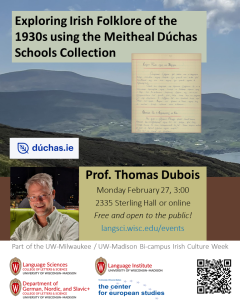 Feb 27Dubois on digital Irish folklore collections
Exploring Irish Folklore of the 1930s using the Meitheal Dúchas Schools Collection Professor Thomas Dubois, Department of German, Nordic, and Slavic+ In person in 2335 Sterling Hall, and online (advanced registration required for online attendance). (Note: you need to be logged in to Zoom to access the recording. Sign in first here. If you don’t …
-
 Feb 24Ling Fridays: Reaser on language awareness
online
Educating the educated: Raising language awareness on campus Linguistics Fridays Colloquia talk Jeffrey Reaser, North Carolina State University In 2014, the Language and Life Project (LLP) at NC State University initiated the nation’s first dialect awareness program focused on the college campus. Since then, members of the LLP and the Language Diversity Ambassadors, a student …
-
Feb 17Ling Fridays: Dillon on Comprehension and Production
online
Principle B: The view from comprehension and production Linguistics Fridays Colloquia talk Brian Dillon, University of Massachussetts Experimental research has shown that the grammatical constraints reflected in (e.g.) the Binding Theory guide real-time pronoun interpretation, albeit perhaps in a defeasible fashion. Evidence for this conclusion comes from a range of experimental evidence that comprehenders selectively …