Past Events
-
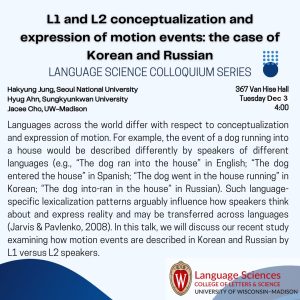 Dec 3Jung, Ahn, & Cho on motion events in Korean and Russian
367 Van Hise
L1 and L2 conceptualization and expression of motion events: the case of Korean and Russian Hakyung Jung (Professor, Department of Russian, Seoul National University, Korea) Hyug Ahn (Associate Professor, Department of Russian, Sungkyunkwan University, Korea) Jacee Cho (Associate Professor, Department of English and Language Sciences, UW–Madison) Abstract Languages across the world differ with respect …
-
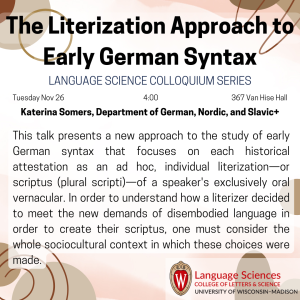 Nov 26Somers on early German Syntax
367 Van Hise
The literization approach to early German syntax Katerina Somers, Department of German, Nordic, & Slavic+ In this talk I present a new approach to the study of early German syntax that focuses on each historical attestation as an ad hoc, individual literization—or scriptus (plural scripti)—of a speaker’s exclusively oral vernacular. I define literization as …
-
 Nov 22Badgers Sign Friendsgiving
Memorial Union (check TITU for location)
Friendsgiving Dinner for Badgers Sign club members and friends. An ASL/voice-off zone event. Cost is $10/person for non-club members (included in dues for club members). Everyone must register to reserve a spot. Semi-formal dress code. Contact badgerssign@gmail.com for questions or more info!
-
Nov 12Panel: Bias in Automatic Speech Recognition
online
Professor Kelly Wright will be participating in an online panel discussion of issues surrounding bias regarding African American Speech in automatic speech recognition systems. Organized by the Center for Applied Linguistics
-
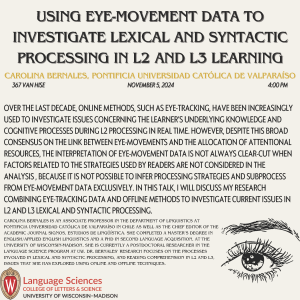 Nov 5Bernales on L2 and L3 Eye-tracking Research
367 Van Hise
Using eye-movement data to investigate lexical and syntactic processing in L2 and L3 learning Carolina Bernales, Pontificia Universidad Católica de Valparaíso Over the last decade, online methods, such as eye-tracking, have been increasingly used to investigate issues concerning the learner’s underlying knowledge and cognitive processes during L2 processing in real time (Bello & Bernales, …
-
 Oct 29
-
Oct 29Romero on Maya standardization
online
Language standardization and colonialism in Guatemala Sergio Romero, University of Texas-Austin In this presentation I examine the tensions between the linguistic purism driving the standardization of Mayan languages in Guatemala, and the social meaning of regional variation in Maya communicational practices. I’ll consider examples from publications, interviews and overheard interactions, and will finish with some …
-
 Oct 29Language & Linguistics Alumni Panel
Online
Learn from recent UW–Madison alumni using their language and linguistic skills across industries domestically and abroad. Gain insight into exploring post-grad plans that suit your language skills and interests. In this virtual panel, you will have the opportunity to ask questions directly to panelists. Advanced registration required. Open to language students and other multilingual …
-
Oct 24Kim on Heritage accent
Memorial Union, Old Madison Room, 3rd floor East wing
Taking a holistic approach to characterizing heritage accent Ji Young Kim, UCLA The way we speak is a reflection of our language experience. While we all have an accent, accent is perceived when someone’s speech is different from the expected variety, be it standard, regional, native or monolingual, depending on the population of interest. …
-
Oct 21Font-Santiago on biological computational language modeling
367 Van Hise
Developing a Biological Computational Model of Natural Language: An Interdisciplinary Approach to Linguistics Cristopher Font-Santiago Ambiguity, the possibility of multiple mental representations and/or interpretations for one utterance, is a necessary, intrinsic, and pervasive feature of natural language. Previous approaches have focused on best capturing individual language modules, such as phonetic-phonological parsers (Church, 1987; Meng, 1995), …