Past Events
-
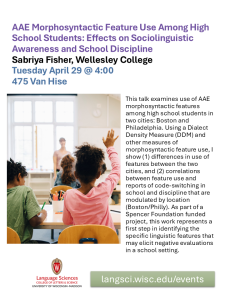 Apr 29Fisher on morphosyntax of AAE
475 Van Hise
AAE Morphosyntactic Feature Use Among High School Students: Effects on Sociolinguistic Awareness and School Discipline Sabriya Fisher, Wellesley College This talk examines use of AAE morphosyntactic features among high school students in two cities: Boston and Philadelphia. Using a Dialect Density Measure (DDM) and other measures of morphosyntactic feature use, I show (1) differences in …
-
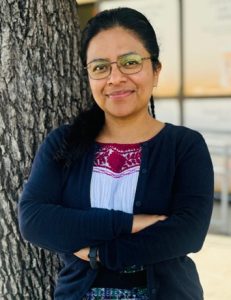 Apr 22Can Pixabaj on Mayan language Mam
Online
The journey of a language and its speakers: Mam of the Chiapas-Guatemala border Telma Can Pixabaj CIMSUR-UNAM (Chiapas, Mexico) The aim of this talk is to share some findings about the state of the Mayan language Mam spoken by a community along the Chiapas-Guatemala border. This variety of Mam is considered at high risk of …
-
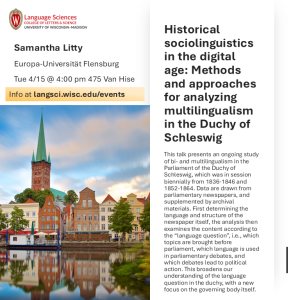 Apr 15Litty on Historical Sociolinguistics
475 Van Hise
Historical sociolinguistics in the digital age: Methods and approaches for analyzing multilingualism in the Duchy of Schleswig Samantha M. Litty, Europa-Universität Flensburg Principal Investigator, Visibilizing Normative Regional Historical Multilingualism: Ideology, Policy, Practice (ViNoRHM) Historically multilingual settings are often characterized by a hidden complexity due to the visibility (or lack thereof) of certain varieties (Davies et …
-
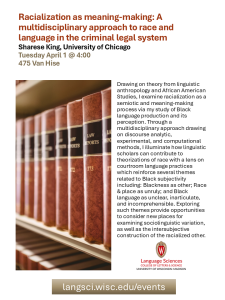 Apr 1King on Race and language in the legal system
475 Van Hise
Racialization as meaning-making: A multidisciplinary approach to race and language in the criminal legal system Sharese King, University of Chicago Despite progress in contiguous fields like sociology and anthropology in complicating essentialist or static views of race, linguistics has lagged in our theorizing of race and language, with our statement on such just being released …
-
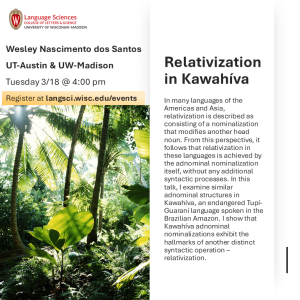 Mar 18dos Santos on Kawahíva Relatives
Online
Relativization in Kawahíva Wesley dos Santos, University of Texas-Austin and UW–Madison In many languages of the Americas and Asia, relativization is described as consisting of a nominalization that modifies another head noun (Yap et al. 2011; Zariquiey et al. 2019). From this perspective, it follows that relativization in these languages is achieved by the adnominal …
-
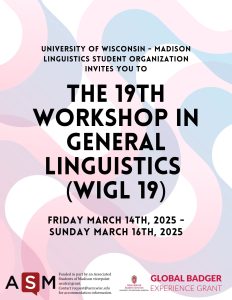 Mar 14Workshop in General Linguistics (WiGL) 19
6191 Helen C. White and online
WiGL 19 will be held on the UW–Madison campus Friday-Saturday March 14-15, 2025, and online on Sunday March 16. See the WiGL homepage for more information about the history of this student-run conference. The deadline for abstract submission was January 17, 2025. See the Call for Papers for more information.
-
Feb 25Pérez González on the Mocho’ Language Documentation Project
online - registration link coming soon
What Can We Learn from the Mocho’ Language Documentation Project? Jaime Pérez González University of California, Santa Barbara In this presentation, I talk about strategies and methodologies that we have implemented in our community-based language documentation project dedicated to preserve and revitalize Mocho’, a highly endangered Mayan language. The project not only involved creating …
-
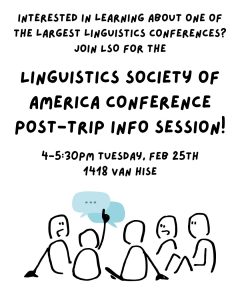 Feb 25LSA conference post-trip info session
1418 Van Hise
The Linguistics Student Org will host an info session on their trip to the Linguistics Society of America annual meeting in January 2025! Over winter break, LSO took a trip to the Linguistics Society of America conference, one of the largest & most prestigious linguistics conferences, funded by a grant from Associate Students of Madison! …
-
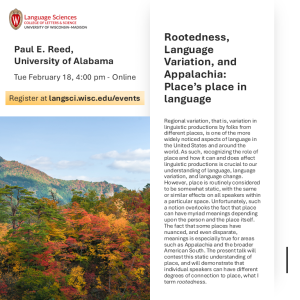 Feb 18Reed on Place in Appalachian English
Online
Rootedness, Language Variation, and Appalachia: Place’s place in language Paul E. Reed, University of Alabama Regional variation, that is, variation in linguistic productions by folks from different places, is one of the more widely noticed aspects of language in the United States and around the world. As such, recognizing the role of place and how …
-
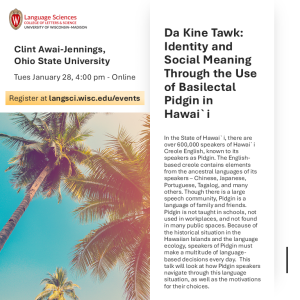 Jan 28Awai-Jennings on social meaning in use of Hawai`i Pidgin
online
Da Kine Tawk: Identity and Social Meaning Through the Use of Basilectal Pidgin in Hawai`i Clint Awai-Jennings, Ohio State University In the State of Hawai`i, there are over 600,000 speakers of Hawai`i Creole English, known to its speakers as Pidgin. Pidgin emerged from the sugarcane plantations in the Hawaiian Kingdom during the last part of …