
Dr. Raimy was the founding director of Language Sciences, and served in this role until 2021.
Teaching
Eng 315: English Phonology
Eng 709: Advanced English Phonology
Ling 373/Eng 713: Topics – Introduction to Statistics and Data Science for Linguists
Ling 310: Phonology
Ling 510: Phonological Theories
Ling 977: Seminar
– Linear Regression for Linguists
– Event-Feature-Precedence Phonology
The Segment in Phonetics and Phonology
Raimy (Co-editor), E., and C. E. Cairns (Co-editor). The Segment in Phonetics and Phonology.
The Segment in Phonetics and Phonology unravels exactly what the segment is and on what levels it exists, approaching the study of the segment with theoretical, empirical, and methodological heterogeneity as its guiding principle. A deliberately eclectic approach to the study of the segment that investigates exactly what the segment is and on what level it exists Includes new research data from a diverse range of fields such as experimental psycholinguistics, language acquisition, and mathematical theories of communication Represents the major theoretical models of phonology, including Articulatory Phonology, Optimality Theory, Laboratory Phonology and Generative Phonology Examines both well-studied languages like English, Chinese, and Japanese and under-studied languages such as Southern Sierra Miwok, Päri, and American Sign Language
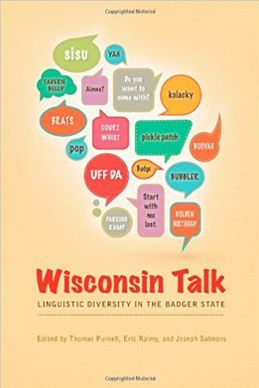
Wisconsin Talk: Linguistic Diversity in the Badger State
Salmons (Co-editor), J., E. Raimy (Co-editor), and T. Purnell (Co-editor). Wisconsin Talk: Linguistic Diversity in the Badger State.
Wisconsin is one of the most linguistically rich places in North America. It has the greatest diversity of American Indian languages east of the Mississippi, including Ojibwe and Menominee from the Algonquian language family, Ho-Chunk from the Siouan family, and Oneida from the Iroquoian family. French place names dot the state’s map. German, Norwegian, and Polish—the languages of immigrants in the nineteenth and early twentieth centuries—are still spoken by tens of thousands of people, and the influx of new immigrants speaking Spanish, Hmong, and Somali continues to enrich the state’s cultural landscape. These languages and others (Walloon, Cornish, Finnish, Czech, and more) have shaped the kinds of English spoken around the state. Within Wisconsin’s borders are found three different major dialects of American English, and despite the influences of mass media and popular culture, they are not merging—they are dramatically diverging. An engaging survey for both general readers and language scholars, Wisconsin Talk brings together perspectives from linguistics, history, cultural studies, and geography to illuminate why language matters in our everyday lives. The authors highlight such topics as: • words distinctive to the state • how recent and earlier immigrants have negotiated cultural and linguistic challenges • the diversity of bilingual speakers that enriches our communities • how maps can convey the stories of language • the relation of Wisconsin’s Indian languages to language loss worldwide.
Handbook of the Syllable
Cairns (Co-editor), C. E., and E. Raimy (Co-editor). Handbook of the Syllable.
The Handbook of the Syllable presents a broad range of empirical studies, offering a comprehensive survey of the syllable in phonology, phonetics, and psycholinguistics. It is a seminal reference book for researchers exploring any empirical area where the notion of “the syllable” is invoked.
Contemporary Views on Architecture and Representations in Phonology
Raimy (Co-editor), E., and C. E. Cairns (Co-editor). Contemporary Views on Architecture and Representations in Phonology.
Leading phonologists discuss contemporary work on the topics of metrical theory, feature theory, syllable theory, and the relation among grammatical modules. The essays in this volume address foundational questions in phonology that cut across different schools of thought within the discipline. The theme of modularity runs through them all, however, and these essays demonstrate the benefits of the modular approach to phonology, either investigating interactions among distinct modules or developing specific aspects of representation within a particular module. Although the contributors take divergent views on a range of issues, they agree on the importance of representations and questions of modularity in phonology. Their essays address the status of phonological features, syllable theory, metrical structure, the architecture of the phonological component, and interaction among components of phonology. In the early 1990s the rise of Optimality Theory–which suggested that pure computation would solve the problems of representations and modularity–eclipsed the centrality of these issues for phonology. This book is unique in offering a coherent view of phonology that is not Optimality Theory based. The essays in this book, all by distinguished phonologists, demonstrate that computation and representation are inherently linked; they do not deny Optimality Theory, but attempt to move the field of phonology beyond it.
The Phonology and Morphology of Reduplication
Raimy, E. The Phonology and Morphology of Reduplication.
This book proposes a new representational analysis of reduplication based on making explicit precedence relations in phonological representations.The main claim is that reduplication results from loops in the precedence structure of phonological representations. Modular rule based analyses of overapplication and underapplication effects including backcopying are presented to argue against the McCarthy and Prince (1995) claim that a derivational model of reduplication is conceptually and empirically inadequate. Other sections of the book discuss the implications of explicit precedence information for the concatenation of morphemes, the analysis of infixation, and templates in reduplication. Analyses of relevant phenomena from Indonesian, Tohono Oodham, Chaha, Chumash and Nancowry among other languages are provided.