
Thomas Purnell
Professor, Director of Language Sciences
6109 Helen C. White Hall
Degrees and Institutions
- PhD Linguistics, University of Delaware, 1998 (“Principles and Parameters of Phonological Rules: Evidence from Tone Languages”)
- MA English (Linguistics), George Mason University, 1992
- BA English, California State University, Los Angeles, 1986
Teaching
Eng 314: Structure of English
Eng 316: English Language Variation in the U.S.
Eng 319: Language, Race, and Identity
Eng 414: Global Spread of English
Eng 416: English in Society
Eng 709: Advanced English Phonology
Eng 905: Seminar – Grammatical and Phonological Patterns in Global Englishes
Ling 510: Phonological Theories
Selected Publications
Edited Volumes
- Wisconsin Talk: Linguistic Diversity in the Badger State. (Madison, WI: University of Wisconsin Press, 2013). (editor, with Eric Raimy & Joseph Salmons)
- “Accommodative tendencies in multidialect communication” Journal of English Linguistics 38/3 (2010). (guest editor with Malcah Yaeger-Dror,)
- “Accommodation to the locally dominant norm: Variationist analyses” American Speech 85/3 (2010). (guest editor with Malcah Yaeger-Dror, )
Articles and chapters
- “The History of English in the United States.” In The Wiley Blackwell Encyclopedia of World Englishes (John Wiley, 2024).
- “Midwestern American Englishes.” In The Wiley Blackwell Encyclopedia of World Englishes (John Wiley, 2024).
- “Old English Vowels: Diachrony, privitivity and phonological representations.” Language 95/4 (2019): e447-e473. (with Eric Raimy & Joseph Salmons)
- “Greeting and Response: Predicting Participation from the Call Opening.” Journal of Survey Statistics and Methodology 6/1 (2018): 122–148. (with Nora Cate Schaeffer, Bo Hee Min, Dana Garbarski & Jennifer Dykema)
- “Rule-Based Phonology: Background, principles and assumptions.” In The Routledge Handbook of Phonological Theory (Routledge, 2017): 135-166.
- “‘Subliminal accent’: Reactions to the rise of Wisconsin English.” Journal of Linguistic Geography 4/1 (2016): 15-30. (with Danielle Schuld, Joe Salmons, and Eric Raimy)
- “Upper Midwestern English.” In Listening to the Past (Cambridge, 2016): 298-324. (with Eric Raimy & Joseph Salmons)
- “Distinctive features, levels of representation and historical phonology.” In The Handbook of Historical Phonology (Oxford, 2015): 522-544. (with Eric Raimy)
- “Hearing the American language change: The state of DARE recordings.” American Speech 88/3 (2013): 275-301.
- “Making linguistics matter: Building on the public’s interest in language.” Linguistic Compass 7/7 (2013): 398-407. (with Eric Raimy & Joseph Salmons)
- “Dialect recordings from the Hanley Collection, 1931-1937.” American Speech 87/4 (2012): 511-513 (audio article).
- “Teaching, researching and doing outreach on Wisconsin Englishes.” American Speech 87/3 (2012): 369-370 (audio article). (with Eric Raimy & Joseph Salmons)
- “Phonetic detail in the perception of ethnic varieties of US English.” In A Reader in Sociophonetics (Mouton de Gruyter, 2010): 289-326.
- “Contact and the development of American English.” In Handbook of Language Contact (Blackwell, 2010/2020): 454-477 (with Joseph Salmons).
- “The vowel phonology of urban Southeastern Wisconsin.” In AAE speakers and their participation in local sound changes: A comparative study. Publication of the American Dialect Society 94 (Duke, 2010): 191-217.
- “Convergence and contact in Milwaukee: Evidence from select African American and white vowel space features.” Journal of Language and Social Psychology 28/4 (2009): 408-427.
- “Phonetic influence on phonological operations.” In Contemporary Views on Architecture and Representations in Phonological Theory (MIT, 2009): 337-354.
- “Defining dialect, perceiving dialect and new dialect formation: Sarah Palin’s speech.” Journal of English Linguistics 37/4 (2009): 331-355. (with Eric Raimy & Joseph Salmons)
- “Pre-velar raising and phonetic conditioning: Role of labial and anterior tongue gestures.” American Speech 83/4 (2008): 373-402.
- “Structured heterogeneity and change in laryngeal phonetics: Upper Midwestern final obstruents.” Journal of English Linguistics 33/4 (2005): 307-338. (with Dilara Tepeli, Jennifer Mercer & Joe Salmons)
- “German substrate effects in Wisconsin English: Evidence for final fortition.” American Speech 80/2 (2005): 135-164. (with Dilara Tepeli & Joe Salmons)
- “Perceptual and phonetic experiments on American English dialect identification.” Journal of Language and Social Psychology 18/1 (1999): 10-30. (with John Baugh & Bill Idsardi)
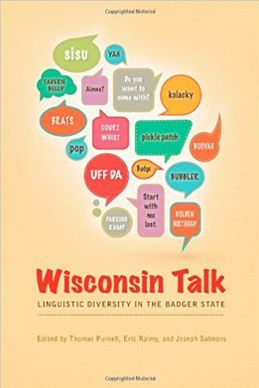
Wisconsin Talk: Linguistic Diversity in the Badger State
Salmons (Co-editor), J., E. Raimy (Co-editor), and T. Purnell (Co-editor). Wisconsin Talk: Linguistic Diversity in the Badger State.
Wisconsin is one of the most linguistically rich places in North America. It has the greatest diversity of American Indian languages east of the Mississippi, including Ojibwe and Menominee from the Algonquian language family, Ho-Chunk from the Siouan family, and Oneida from the Iroquoian family. French place names dot the state’s map. German, Norwegian, and Polish—the languages of immigrants in the nineteenth and early twentieth centuries—are still spoken by tens of thousands of people, and the influx of new immigrants speaking Spanish, Hmong, and Somali continues to enrich the state’s cultural landscape. These languages and others (Walloon, Cornish, Finnish, Czech, and more) have shaped the kinds of English spoken around the state. Within Wisconsin’s borders are found three different major dialects of American English, and despite the influences of mass media and popular culture, they are not merging—they are dramatically diverging. An engaging survey for both general readers and language scholars, Wisconsin Talk brings together perspectives from linguistics, history, cultural studies, and geography to illuminate why language matters in our everyday lives. The authors highlight such topics as: • words distinctive to the state • how recent and earlier immigrants have negotiated cultural and linguistic challenges • the diversity of bilingual speakers that enriches our communities • how maps can convey the stories of language • the relation of Wisconsin’s Indian languages to language loss worldwide.